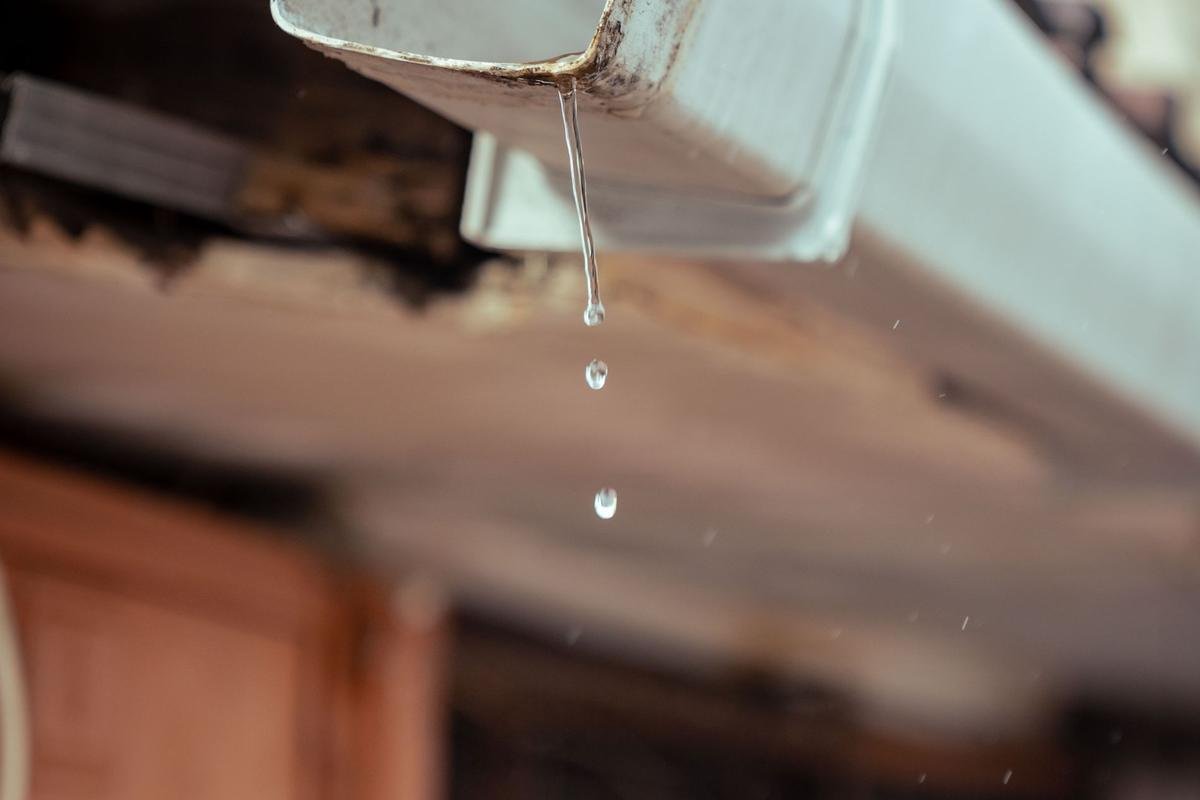
Eavestrough is the cheapest water management a house has, and the most commonly undersized. Everything it fails to carry ends up against your foundation.
Sectional eavestrough joins every few feet, and every joint is a future leak. Seamless trough is roll-formed on site to the exact length of your run, so the only joints are at corners and outlets. Fewer seams, fewer failures, and a cleaner line along the fascia.
Five inch or six
Five-inch is the residential default and it is fine on a modest roof. Six-inch carries substantially more water and pairs with larger downspouts — it is the right call on a big roof area, a steep pitch that dumps water fast, or any elevation where a valley concentrates runoff into one short section of trough.
Undersized trough does not fail dramatically. It overshoots in heavy rain, which you mostly notice as water running down the wall and pooling at the foundation. We size it to your actual roof rather than to whatever was there before, because what was there before is frequently the problem.
Downspouts and where the water goes
Enough downspouts for the trough length, not the minimum that fits
Discharged well away from the foundation, not beside it
Extensions and splash blocks where grading needs help
Kickouts at roof-wall intersections so water does not run behind siding
Ice, snow and Ontario winters
Our winters put eavestrough through cycles nothing else in the house experiences: fill, freeze, expand, thaw, repeat. Hangers matter. We use hidden hangers screwed into the fascia at proper spacing rather than the old spike-and-ferrule approach, which works loose as the wood moves and eventually lets a loaded trough pull away.
If you get persistent ice dams, the eavestrough is a symptom rather than a cause — the real problem is usually attic ventilation, which is why soffit matters more than people expect.
How we work
Built for an Ontario winter
Everything we hang on the outside of a house has to survive roughly a hundred freeze-thaw cycles a year. That changes the details.
We look behind it first. On any tear-off we open a section and tell you what the wall is actually doing before quoting the whole job.
Room to move. Vinyl expands and contracts a long way between February and August. Fastened tight, it buckles and splits. We hang it.
Water gets out. House wrap lapped so it drains, flashing that sheds outward, kickouts where a roof meets a wall.
One trade, one edge. Siding, soffit, fascia and eavestrough all meet at the same line. Doing them together is how that line ends up straight.
Every photo is a Cave-Men job in southwestern Ontario. Tap any one to see it full size.
Questions
Eavestrough FAQ
What is the difference between eavestrough and gutters?
Nothing except the word. Eavestrough is what we call it in Canada; gutter is the American term. Same product, same job.
Should I get 5-inch or 6-inch?
It depends on your roof area and pitch. Six-inch is worth it on large or steep roofs and anywhere a valley dumps a lot of water into one short run. We will size it on your actual roof rather than matching whatever was there.
Will new eavestrough stop my ice dams?
Probably not on its own, and anyone promising that is overselling. Ice dams come from heat escaping into the attic and melting snow that refreezes at the cold eave. The fix is usually attic ventilation - soffit intake and roof exhaust - and insulation. We will tell you honestly what is going on.